
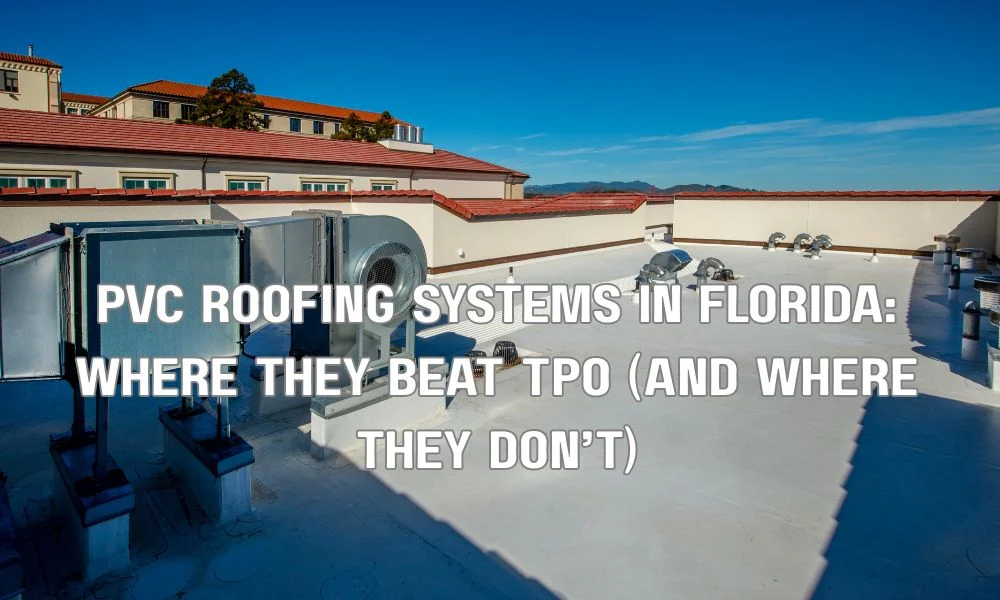
Executive Summary
- PVC roofing offers superior chemical and grease resistance, making it ideal for Florida commercial kitchens and industrial facilities prone to such exposures.
- While TPO is more budget-friendly upfront, PVC typically boasts a longer lifespan and lower lifecycle costs due to its robust durability against Florida’s extreme UV and heat.
- PVC’s weld seams are inherently stronger and more resistant to thermal expansion and contraction, which is a critical factor for preventing leaks in Florida’s fluctuating temperatures.
- For high-wind zones and hurricane-prone areas in Florida, the exceptional tear strength and puncture resistance of PVC provide enhanced protection and peace of mind.
- Property owners should prioritize PVC for applications demanding peak performance and longevity in Florida’s harsh climate, despite its higher initial investment.
- TPO remains a strong contender for projects where initial cost savings are paramount and the roof is not exposed to specific chemical contaminants.
- Understanding the specific environmental stresses on your Florida roof is crucial for selecting the optimal single-ply membrane between PVC and TPO.
Understanding Single-Ply Roofing in Florida
Florida’s climate presents a unique and demanding environment for commercial roofing systems, characterized by intense UV radiation, high humidity, torrential downpours, and the constant threat of hurricane-force winds. These factors necessitate roofing solutions that are not only durable but also highly resilient and energy-efficient. Single-ply membranes have emerged as a dominant choice for low-slope and flat commercial roofs across the state due to their excellent performance characteristics under these conditions.
Critical Fact 1: Florida’s average annual UV index is significantly higher than the national average, accelerating the degradation of many roofing materials, making UV resistance a paramount selection criterion.
What are the primary challenges for roofing systems in Florida?
The primary challenges for roofing systems in Florida include relentless UV exposure, which can degrade membranes and adhesives, extreme heat that causes significant thermal expansion and contraction, and high humidity fostering mold and mildew growth. Additionally, the state’s susceptibility to hurricanes and severe thunderstorms demands systems with exceptional wind uplift resistance and watertight integrity. These environmental stressors collectively test the limits of any roofing material, making material selection a critical decision for long-term performance.
Why are single-ply membranes so popular for commercial buildings here?
Single-ply membranes are incredibly popular for commercial buildings in Florida primarily due to their lightweight nature, ease of installation, and inherent flexibility, which allows them to adapt to building movement without cracking. Their reflective surfaces contribute to energy efficiency by reducing cooling loads, a significant advantage in Florida’s hot climate. Furthermore, modern single-ply systems offer excellent waterproofing capabilities and are engineered to withstand the specific environmental challenges prevalent in the region, providing a reliable and cost-effective solution for a wide range of commercial applications.
PVC Roofing Systems: The Robust Choice
Polyvinyl Chloride (PVC) roofing systems are renowned for their exceptional durability and performance in harsh environments, making them a premium choice for many commercial applications in Florida. These membranes are thermoplastic, meaning they are heat-welded at seams to create a monolithic, watertight surface that is incredibly resistant to moisture penetration. Their unique chemical composition provides a strong defense against a variety of damaging agents often found in commercial settings.
What are the key advantages of PVC roofing in Florida’s climate?
The key advantages of PVC roofing in Florida’s climate include superior chemical resistance, particularly to animal fats and grease, making it ideal for restaurants and food processing plants. PVC boasts excellent puncture and tear resistance, crucial for protecting against debris during storms and incidental foot traffic. Its heat-welded seams are incredibly strong, offering unparalleled watertight integrity against torrential Florida rains and high winds. Furthermore, PVC maintains its flexibility in extreme temperatures and offers inherent fire resistance, contributing to overall building safety.
Are there any significant drawbacks to consider with PVC?
While PVC offers numerous benefits, some significant drawbacks to consider include its higher initial material and installation cost compared to TPO. The manufacturing process of PVC involves plasticizers, which can leach out over many years, potentially making older membranes more brittle, although modern PVC formulations have significantly improved in this regard. Additionally, PVC can be less flexible in extremely cold temperatures, which, while rare in Florida, is a general characteristic to note. Its limited color options, typically white or gray, might also be a minor consideration for aesthetic purposes.
TPO Roofing Systems: The Cost-Effective Contender
Thermoplastic Polyolefin (TPO) roofing systems have rapidly gained popularity as a cost-effective and energy-efficient option for commercial buildings, particularly appealing to those looking for a balance between performance and budget. TPO membranes are also thermoplastic and feature heat-welded seams, offering a strong, continuous surface. They are recognized for their reflective properties and good resistance to UV radiation, making them a common choice in sunny climates like Florida.
What makes TPO a popular option for commercial roofs in Florida?
TPO is a popular option for commercial roofs in Florida primarily due to its attractive balance of cost-effectiveness, energy efficiency, and reliable performance. Its white or light-colored surfaces reflect sunlight, significantly reducing cooling costs during Florida’s hot summers. TPO offers good resistance to UV radiation, punctures, and tears, and its heat-welded seams provide robust protection against water infiltration. The material is relatively lightweight and quicker to install than some other systems, translating to lower labor costs.
Where does TPO fall short compared to PVC in Florida’s harsh conditions?
TPO can fall short compared to PVC in Florida’s harsh conditions primarily concerning its long-term seam strength and chemical resistance. While TPO seams are heat-welded, some studies and field observations suggest they may be more susceptible to degradation from thermal expansion and contraction over extended periods than PVC, potentially leading to breaches. TPO also has significantly lower resistance to animal fats, oils, and some industrial chemicals, making it less suitable for applications like commercial kitchens. Its puncture resistance, while good, generally does not match PVC’s superior performance, which is crucial during storm cleanup or routine maintenance.
Critical Fact 2: While both PVC and TPO use heat-welded seams, PVC welds typically demonstrate a higher peel and shear strength, maintaining integrity better over decades of thermal cycling.
Direct Comparison: PVC vs. TPO for Florida’s Unique Demands
When selecting a single-ply membrane for a commercial roof in Florida, a direct comparison of PVC and TPO reveals distinct advantages and disadvantages tailored to the region’s specific environmental stressors. Understanding these differences is crucial for making an informed decision that ensures long-term performance and value. This section delves into key performance metrics, from UV resistance to cost implications, to highlight where each system excels.
Which system offers superior long-term performance against UV and heat?
Both PVC and TPO offer good long-term performance against UV and heat, but PVC generally holds an edge in extreme, prolonged exposure. PVC’s chemical structure is inherently more stable and less prone to embrittlement over decades of intense solar radiation and high temperatures prevalent in Florida. While TPO has improved significantly in UV resistance, some formulations can show earlier signs of chalking or surface degradation over very long periods compared to premium PVC.
How do they compare in terms of puncture resistance and seam integrity?
In terms of puncture resistance, PVC typically outperforms TPO due to its stronger polymer matrix and reinforcement, making it a more robust choice against hail, dropped tools, or sharp debris. Regarding seam integrity, both systems rely on heat welding, but PVC welds are widely regarded as stronger and more consistent. The robust chemical bond created during PVC welding offers superior resistance to peeling and shearing forces, providing a more reliable watertight seal against Florida’s heavy rains and strong winds over the roof’s lifespan.
What are the cost implications for installation and lifecycle of each?
The cost implications for installation and lifecycle reveal that TPO typically has a lower upfront material and installation cost, making it attractive for budget-conscious projects. However, PVC often boasts a longer expected service life—ranging from 20-30+ years compared to TPO’s 15-25 years—which can translate to lower lifecycle costs over time due to fewer repairs and less frequent replacement. When considering long-term value, including energy savings, maintenance, and durability, PVC often provides a better return on investment despite its higher initial price tag.
| Feature/Characteristic | PVC Roofing System | TPO Roofing System |
|---|---|---|
| **Initial Cost (Material + Install)** | Higher ($8.00 – $12.00+ / sq. ft.) | Lower ($6.00 – $10.00 / sq. ft.) |
| **Expected Lifespan (Florida)** | 20-30+ Years | 15-25 Years |
| **Chemical/Grease Resistance** | Excellent | Good to Fair (Poor for fats/oils) |
| **Puncture/Tear Resistance** | Superior | Good |
| **Seam Strength** | Excellent (Highest weld strength) | Very Good (Can be prone to thermal expansion issues over time) |
| **UV Resistance** | Excellent (Long-term stability) | Very Good (Can show surface degradation over decades) |
| **Fire Resistance** | Self-extinguishing (Class A) | Good (Class A with additives) |
| **Recyclability** | Highly Recyclable | Limited Recyclability |
Making the Right Choice for Your Florida Property
Deciding between PVC and TPO for your Florida commercial roof involves carefully weighing the specific demands of your building, your budget constraints, and your long-term performance expectations. There are clear scenarios where one system stands out as the unequivocally better choice, while in others, both can be viable solutions depending on the priority. This section aims to guide property owners in making that critical distinction, focusing on optimal application scenarios for each material.
When is PVC the unequivocal better choice for Florida?
PVC is the unequivocal better choice for Florida properties when chemical resistance is critical, such as for restaurants, food processing plants, or manufacturing facilities that may expose the roof to animal fats, oils, or industrial chemicals. It’s also superior for roofs expecting heavy foot traffic or prone to debris impact due to its higher puncture and tear resistance. For buildings where longevity, maximum watertight integrity against hurricanes, and lower lifecycle costs over 20+ years are paramount, the initial investment in PVC is well justified.
When might TPO still be a viable and cost-effective solution?
TPO might still be a viable and cost-effective solution for Florida properties where initial cost savings are a primary driver and the roof is not exposed to harsh chemicals or exceptionally heavy traffic. It’s an excellent choice for general commercial applications like retail stores, offices, or warehouses where energy efficiency through reflectivity is a key benefit. When installed correctly and maintained adequately, TPO can provide reliable performance for many years, offering a strong balance of upfront affordability and reasonable durability in the Florida climate.
Critical Fact 3: The choice between PVC and TPO should always factor in the specific building occupancy and potential roof contaminants, as chemical exposure is a major differentiator in their long-term performance.
Frequently Asked Questions
Is PVC roofing better than TPO in Florida’s hurricane zones?
Yes, PVC often performs better in Florida’s hurricane zones due to its superior tear strength and stronger heat-welded seams, which offer enhanced wind uplift resistance. Its higher puncture resistance also helps protect against wind-borne debris.
How do PVC and TPO compare in terms of energy efficiency in Florida?
Both PVC and TPO, especially in white or light colors, offer excellent energy efficiency by reflecting sunlight and reducing cooling loads. They are comparable in this aspect, helping buildings meet energy codes and lower utility bills.
What is the typical lifespan difference between PVC and TPO in Florida?
In Florida’s climate, PVC roofing typically lasts 20-30+ years, while TPO systems usually have a lifespan of 15-25 years. This difference often makes PVC a more cost-effective choice over its entire lifecycle.
Can PVC and TPO roofs be repaired in Florida after storm damage?
Yes, both PVC and TPO roofs are highly repairable. Minor punctures or tears can be heat-welded with new membrane patches, extending the roof’s life and restoring its watertight integrity after storm damage.
Which material is more environmentally friendly for Florida roofing?
Both materials have environmental considerations. PVC is highly recyclable and has a long service life, reducing waste. TPO is often seen as “greener” because it doesn’t use chlorine, but it’s less recyclable than PVC at present.
Is the installation process different for PVC and TPO in Florida?
The installation process for both PVC and TPO involves similar techniques, primarily mechanical fastening or fully adhering the membrane and then heat-welding the seams. Local Florida building codes and wind uplift requirements might influence specific installation methods.
Do PVC or TPO roofs require special maintenance in Florida?
Both PVC and TPO roofs benefit from regular inspections and cleaning, especially after severe weather events, to remove debris and check for any potential issues. This proactive maintenance is crucial for maximizing their lifespan in Florida’s climate.
Which roofing system is better for roofs with many penetrations or complex designs in Florida?
Both systems are suitable for roofs with many penetrations or complex designs because their flexibility allows for intricate detailing around pipes, vents, and HVAC units. However, PVC’s superior seam strength and workability can be an advantage for highly detailed areas.
