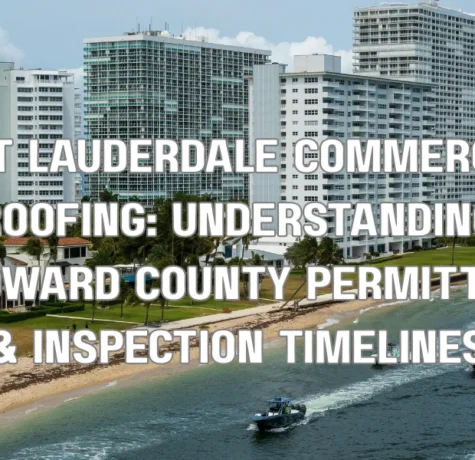
[[INSTRUCTION: ]] # Fort Lauderdale Commercial Roofing: Understanding Broward County Permitting & Inspection Timelines Executive Summary All commercial roofing projects in Fort Lauderdale require strict adherence to Broward County permitting regulations, ensuring structural integrity and public safety. Early engagement with experienced commercial roofing contractors streamlines the permit application process, mitigating common delays and compliance issues. Typical permit processing times in Broward County range from 2-4 weeks, though complex projects may require longer review periods and additional documentation. Mandatory mid-roof and final inspections are critical for project approval, verifying work aligns with approved plans and local building codes. Proactive scheduling of inspections and meticulous documentation significantly reduces re-inspection needs, accelerating project completion timelines. Non-compliance with permitting and inspection protocols can lead to substantial fines, stop-work orders, and potential legal liabilities for property owners. Leveraging a professional roofing contractor with deep local regulatory knowledge is paramount for efficient, code-compliant, and timely project delivery. Navigating Commercial Roofing Permits in Fort Lauderdale Why are commercial roofing permits essential in Broward County? Commercial roofing permits are essential in Broward County to ensure all construction and repair work meets stringent safety standards and local building codes. These permits protect property owners, occupants, and the public by mandating professional oversight and adherence to structural integrity requirements. Without proper permitting, projects risk significant legal and financial penalties, compromising future property sales and insurance claims. Critical Fact 1: Broward County regulations stipulate that any alteration, repair, or replacement of commercial roofing systems exceeding a minor cosmetic patch requires a permit to ensure structural integrity and public safety. What types of commercial roofing projects require a permit? Virtually all commercial roofing projects in Fort Lauderdale, beyond minor cosmetic repairs, necessitate a permit from Broward County. This includes full roof replacements, significant structural repairs, re-roofing over existing layers, and any new construction involving the roof system. Even projects that seem minor, such as installing new HVAC units that penetrate the roof, often trigger permit requirements to ensure water-tightness and load-bearing capacity. It is always safest to consult with a licensed contractor or the local building department to confirm specific permit needs for your project. Deconstructing the Permitting Process in Broward County What is the typical permitting application process for commercial roofing? The typical permitting application process for commercial roofing in Broward County begins with the submission of detailed plans and specifications by a licensed contractor. This package usually includes architectural drawings, structural calculations, product specifications, and a completed permit application form. Once submitted, the plans undergo review by various county departments, including zoning, building, and sometimes environmental services, to ensure full compliance with all local ordinances and state building codes. Any deficiencies noted during this review will require revisions before approval. How long does it generally take to obtain a commercial roofing permit? Generally, obtaining a commercial roofing permit in Broward County can take anywhere from 2 to 4 weeks, depending on the complexity of the project and the completeness of the initial submission. Factors such as current workload at the building department, the need for multiple departmental reviews, and any required revisions to plans can extend this timeline significantly. Expedited permit services may be available for an additional fee, but this is not always guaranteed and depends on the specific municipality within Broward County. Understanding Commercial Roofing Inspection Timelines and Requirements What are the key stages of commercial roofing inspections? Key stages of commercial roofing inspections in Broward County typically involve a mid-roof inspection and a final inspection. The mid-roof inspection occurs after the old roofing material has been removed (if applicable) and the new substrate or underlayment has been installed, but before the final roofing material is applied. This inspection ensures proper decking, insulation, and flashing installation. The final inspection takes place once all roofing work is complete, verifying the finished product meets all code requirements, including securement, waterproofing, and aesthetic standards. How quickly can inspections be scheduled and completed in Broward County? Scheduling inspections in Broward County can often be done within 1-3 business days of the request, provided the project is ready and all prerequisites are met. However, actual completion times can vary based on inspector availability and the complexity of the inspection itself. If an inspection fails, a re-inspection must be scheduled after corrections are made, adding further time to the project timeline. Efficient communication and readiness significantly impact how quickly inspections are completed. Critical Fact 2: Failed inspections are a primary cause of project delays in commercial roofing; ensuring the site is ready and all work is to code before requesting inspection can save days or even weeks. Mitigating Delays and Ensuring Compliance How can project delays be minimized during the permitting and inspection phases? Minimizing project delays during permitting and inspection phases requires meticulous planning and a proactive approach. Engaging a reputable commercial roofing contractor familiar with Broward County’s specific regulations is paramount. They can ensure accurate, complete permit applications, preventing common rejections. Additionally, having the job site fully prepared and accessible for inspectors, with all necessary documentation on hand, will facilitate smooth, timely inspections and avoid costly re-inspections. What are the consequences of non-compliance with Broward County roofing regulations? Non-compliance with Broward County roofing regulations carries severe consequences, including significant financial penalties, stop-work orders, and potential legal actions. Property owners may face daily fines for unpermitted work, be forced to remove non-compliant installations, or even be unable to sell their property without rectifying the issues. Furthermore, unpermitted work can void insurance policies and pose substantial safety risks to building occupants, leading to severe liabilities. Key Data: Broward County Commercial Roofing Permit & Inspection Overview Navigating the regulatory landscape for commercial roofing in Fort Lauderdale requires a clear understanding of typical permit types, required documentation, estimated processing times, and associated fees. The table below provides a general overview, though specific costs and timelines can vary based on the project’s scope, municipality, and prevailing county workloads. Permit Type / Stage Typical Documentation Required Estimated Processing/Scheduling Time Potential Associated Fees (Approx.) New Commercial Roof Installation Architectural plans, structural calculations, product specs, NOA/FL approvals 3-5 Weeks (Permit) $500 – $5000+ (Based on project value) Commercial Roof Replacement (Re-roof) Existing roof survey, new material specs, NOA/FL approvals, asbestos survey (if applicable) 2-4 Weeks (Permit) $300 – $3000+ Commercial Roof Repair (Major) Scope of work, material specs, site plan showing repair area 1-3 Weeks (Permit) $150 – $1000+ Mid-Roof Inspection Approved permit, accessible roof, installed underlayment/insulation 1-3 Business Days (Scheduling) Included in permit fee (Re-inspections may incur fees) Final Inspection Approved permit, completed roof, manufacturer warranties, final documentation 1-3 Business Days (Scheduling) Included in permit fee (Re-inspections may incur fees) This data highlights the importance of thorough preparation and professional guidance to ensure a smooth permitting and inspection journey. Critical Fact 3: Engaging a commercial roofing contractor with a proven track record of successful projects in Fort Lauderdale and a deep understanding of Broward County’s specific permit and inspection protocols is the single most effective way to ensure project success and compliance. Frequently Asked Questions Q1: How long does a commercial roofing permit take in Fort Lauderdale? For a standard commercial reroofing project with a complete submittal package, Fort Lauderdale’s Building Services typically completes plan review in 5–10 business days. Total time from submittal to permit issuance—including any corrections—averages 10–18 business days for experienced contractors. Shieldline’s average is 8–12 business days due to pre-submission quality control. Projects requiring structural engineering review or energy compliance calculations take 15–25 business days. Q2: What documents are required to pull a commercial roofing permit in Broward County? Required documents include: a completed permit application, proof of contractor licensure (State of Florida Certified Roofing Contractor), certificates of insurance (GL and Workers’ Comp), Florida Product Approvals (FL#) for all primary materials, a roofing scope narrative, and for projects involving structural work or exceeding certain size thresholds, a signed/sealed engineering plan. Missing or mismatched product approvals are the most common cause of submittal rejection. Q3: Can a commercial roof in Fort Lauderdale be replaced without a permit? No—and attempting to do so carries significant risks. Unpermitted commercial roofing work can trigger stop-work orders, mandatory tear-off and re-inspection, fines of up to $5,000 per violation, and creates liability for both the property owner and contractor. More practically, unpermitted roofs are undisclosed material defects in commercial real estate transactions that can void a sale. Manufacturers also require permits as a condition of commercial warranty registration. Q4: What causes Fort Lauderdale commercial roofing permit delays? The four most common causes of delay are: (1) incomplete product approval documentation or FL# numbers that do not match the proposed installation method; (2) contractor license not current in the City or County system; (3) projects that unintentionally trigger energy code upgrade requirements not addressed in the initial submittal; and (4) plan reviewer workload spikes following major storm events, which can extend review times by 2–4 weeks system-wide. Q5: Are roofing inspections required for commercial projects in Fort Lauderdale? Yes. At minimum, a dry-in inspection (after substrate and base layer but before final membrane) and a final inspection are required for all commercial roofing replacements. For tear-off projects where deck condition must be verified, a deck inspection may be added. Inspections that fail require re-inspection after corrections, which adds 2–5 business days. Shieldline’s installation quality control process is designed to achieve first-attempt inspection passes on 95%+ of projects. Q6: How does Broward County permitting differ for commercial roofing vs. residential roofing? Commercial roofing permits in Broward County involve more rigorous documentation requirements, including energy code compliance verification, greater scrutiny of product approvals for larger systems, and more complex inspection sequences for large buildings. Residential permits are more standardized and often processed faster. Commercial projects also frequently require an engineer’s letter or signed/sealed drawings for anything involving structural modifications, whereas residential reroofs rarely do unless the structure has unusual conditions. Q7: What is the role of a roofing permit specialist, and should I hire one for my Fort Lauderdale commercial project? A permit specialist prepares, submits, and tracks the permit application through the municipal review process, resolving deficiency notices and coordinating inspections. For commercial projects, using a contractor with an in-house permit specialist (rather than a third-party expediter or leaving permitting to the field superintendent) consistently reduces total project timelines. Shieldline’s dedicated permitting staff has processed permits in every Broward municipality and maintains direct relationships with plan reviewers, resulting in faster resolution of technical questions. { "@context": "https://schema.org", "@type": "FAQPage", "mainEntity": [ { "@type": "Question", "name": "How long does a commercial roofing permit take in Fort Lauderdale?", "acceptedAnswer": { "@type": "Answer", "text": "For a standard commercial reroofing project with a complete submittal package, Fort Lauderdale's Building Services typically completes plan review in 5–10 business days. Total time from submittal to permit issuance, including any corrections, averages 10–18 business days for experienced contractors. Shieldline's average is 8–12 business days due to pre-submission quality control. Projects requiring structural engineering review or energy compliance calculations take 15–25 business days." } }, { "@type": "Question", "name": "What documents are required to pull a commercial roofing permit in Broward County?", "acceptedAnswer": { "@type": "Answer", "text": "Required documents include a completed permit application, proof of contractor licensure (State of Florida Certified Roofing Contractor), certificates of insurance (General Liability and Workers' Compensation), Florida Product Approvals (FL#) for all primary materials, a roofing scope narrative, and for projects involving structural work or exceeding certain size thresholds, a signed and sealed engineering plan. Missing or mismatched product approvals are the most common cause of submittal rejection." } }, { "@type": "Question", "name": "Can a commercial roof in Fort Lauderdale be replaced without a permit?", "acceptedAnswer": { "@type": "Answer", "text": "No. Unpermitted commercial roofing work can trigger stop-work orders, mandatory tear-off and re-inspection requirements, fines of up to $5,000 per violation, and liability for both the property owner and contractor. Unpermitted roofs may also be considered undisclosed material defects in commercial real estate transactions, potentially affecting a sale. Manufacturers commonly require permits as a condition of commercial warranty registration." } }, { "@type": "Question", "name": "What causes Fort Lauderdale commercial roofing permit delays?", "acceptedAnswer": { "@type": "Answer", "text": "The four most common causes of delay are: incomplete product approval documentation or FL# numbers that do not match the proposed installation method; contractor licenses that are not current in the City or County system; projects that trigger energy code upgrade requirements not addressed in the initial submittal; and plan reviewer workload spikes following major storm events, which can extend review times by 2–4 weeks." } }, { "@type": "Question", "name": "Are roofing inspections required for commercial projects in Fort Lauderdale?", "acceptedAnswer": { "@type": "Answer", "text": "Yes. At minimum, a dry-in inspection after substrate and base layer installation but before the final membrane, and a final inspection, are required for all commercial roofing replacements. For tear-off projects where deck condition must be verified, a deck inspection may also be required. Failed inspections require corrections and re-inspection, typically adding 2–5 business days to the project timeline. Shieldline's quality control process is designed to achieve first-attempt inspection passes on more than 95 percent of projects." } }, { "@type": "Question", "name": "How does Broward County permitting differ for commercial roofing vs. residential roofing?", "acceptedAnswer": { "@type": "Answer", "text": "Commercial roofing permits in Broward County involve more rigorous documentation requirements, including energy code compliance verification, greater scrutiny of product approvals for larger roofing systems, and more complex inspection sequences for large buildings. Residential permits are generally more standardized and often processed faster. Commercial projects frequently require an engineer's letter or signed and sealed drawings for structural modifications, while residential reroofs rarely require them unless unusual structural conditions exist." } }, { "@type": "Question", "name": "What is the role of a roofing permit specialist, and should I hire one for my Fort Lauderdale commercial project?", "acceptedAnswer": { "@type": "Answer", "text": "A permit specialist prepares, submits, and tracks permit applications through the municipal review process, resolves deficiency notices, and coordinates inspections. For commercial roofing projects, working with a contractor that has an in-house permit specialist can reduce overall project timelines compared to relying on a third-party expediter or field superintendent. Shieldline's permitting staff has processed permits across Broward County municipalities and works directly with plan reviewers to help resolve technical questions efficiently." } } ] }