
Executive Summary
- Proper roof deck attachment and fastening patterns are critical for mitigating severe wind damage, especially in Florida’s hurricane-prone regions.
- Adhering to Florida Building Code (FBC) fastening specifications significantly enhances a roof’s resistance to uplift forces during high-wind events.
- Investing in robust attachment methods can lead to substantial reductions in homeowner insurance premiums through wind mitigation credits.
- Superior fastening patterns ensure the structural integrity of your home, protecting occupants and valuable property from storm devastation.
- Understanding the specific requirements for different wind zones empowers homeowners to make informed decisions for long-term safety and resilience.
- Going beyond minimum code standards offers added protection, increasing a roof’s lifespan and reducing future repair costs.
Understanding Florida’s Unique Wind Challenges
Why are Florida’s wind zones particularly demanding for roof decks?
Florida’s geographic location makes it highly susceptible to tropical storms and hurricanes, exposing buildings to extreme wind forces that demand exceptional structural resilience. The state’s extensive coastline and flat topography offer little natural protection, allowing high winds to buffet structures intensely. These conditions necessitate stringent building codes, particularly for roof systems, to prevent catastrophic failures during severe weather events.
Critical Fact 1: Florida’s High-Velocity Hurricane Zone (HVHZ), encompassing Miami-Dade and Broward counties, mandates some of the strictest building codes in the nation, including enhanced roof deck attachment requirements.
The primary concern for roof decks in these zones is wind uplift – the negative pressure created as wind flows over and around a roof, attempting to lift the entire assembly off the building. Without adequate attachment, this uplift can tear off roof sheathing, exposing the interior to rain and further damage. Florida Building Code (FBC) provisions are specifically designed to counteract these powerful forces, ensuring that roof decks remain securely fastened even under the most extreme conditions. This focus on wind resistance is paramount for protecting lives and property across the state.
The Core Mechanics of Roof Deck Attachment
How does proper roof deck attachment prevent wind uplift?
Proper roof deck attachment prevents wind uplift by creating a robust mechanical connection between the roof sheathing and the underlying framing (trusses or rafters), distributing and resisting the upward forces generated by high winds. When wind blows over a roof, it creates a vacuum effect, attempting to pull the sheathing upwards and detach it from the structure. By securing the sheathing effectively, the cumulative strength of numerous fasteners directly counters this lifting force, maintaining the roof’s integrity.
This critical connection ensures that the entire roof system acts as a unified diaphragm, transferring loads efficiently throughout the building’s frame. In essence, a well-fastened roof deck prevents individual sheathing panels from peeling off, which could lead to widespread structural damage and interior exposure to the elements. The strength of this attachment is directly proportional to the number and type of fasteners used, as well as their strategic placement.
What are the different types of fasteners used for roof decks?
The most common fasteners used for roof decks are nails, particularly 8d common smooth shank or ring shank nails. Ring shank nails are generally preferred in high-wind zones due to their superior withdrawal resistance, meaning they are much harder for wind uplift to pull out. These fasteners typically range from 2 to 2.5 inches in length, ensuring adequate penetration into the roof framing members (trusses or rafters) for a secure hold.
While nails are standard, screws can also be used, particularly in specific repair situations or for enhanced fastening, though they are less common for initial installation due to cost and labor. The choice of fastener material (e.g., hot-dipped galvanized for corrosion resistance) is also crucial, especially in coastal Florida environments where humidity and salt exposure can degrade fasteners over time. Proper fastener size, material, and sufficient penetration are non-negotiable for achieving the required uplift resistance.
Fastening Patterns: The Unsung Hero of Wind Resistance
How do specific fastening patterns enhance wind uplift resistance?
Specific fastening patterns enhance wind uplift resistance by strategically distributing fasteners to counteract the varied pressures exerted across a roof deck during high-wind events. Wind pressure is not uniform; it’s typically highest at the perimeter and corners of a roof, where uplift forces are concentrated. Denser fastening patterns in these critical zones, compared to the less exposed field areas, ensure that the roof deck has maximum resistance where it needs it most.
By placing fasteners at prescribed intervals, these patterns create a distributed load path, preventing stress from concentrating at a few weak points. Closer spacing increases the number of connection points, exponentially improving the collective holding power of the entire roof deck. This engineered approach ensures that the sheathing remains firmly attached even under extreme suction pressures, significantly reducing the risk of catastrophic roof failure.
What are common fastening patterns mandated by Florida building codes?
Florida Building Codes mandate specific fastening patterns based on wind zone, roof geometry, and desired uplift resistance, with common patterns often expressed as edge/field spacing. A standard pattern might be 6/12, meaning fasteners are placed 6 inches on center along panel edges (where uplift is highest) and 12 inches on center in the field of the panel. For higher wind zones or specific components, stricter patterns like 4/8 or even 4/6 are often required, indicating closer spacing and thus greater resistance.
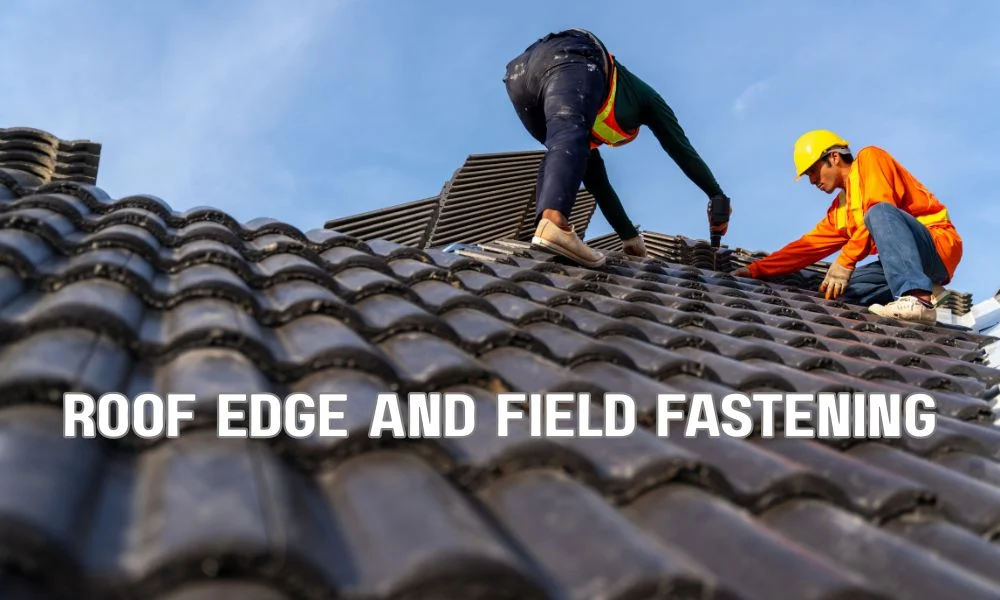
These patterns are critical for meeting the FBC’s uplift resistance requirements, which are determined by engineers based on design wind speeds. Adherence to these patterns is verified during inspections and is a key factor in a home’s overall wind mitigation.
Critical Fact 2: In the strongest wind zones, such as Florida’s HVHZ, roof deck sheathing often requires 8d ring shank nails at 4 inches on center along all edges and 6 inches on center in the field, representing one of the highest attachment standards.
The following table illustrates typical fastening patterns and their implications:
| Fastening Pattern (Edge/Field) | Typical Fastener Spacing (inches) | Uplift Pressure Resistance (psf – approximate) | Application Zone | Fastener Type (Example) |
|---|---|---|---|---|
| 6/12 Standard | 6″ edge, 12″ field | 50-60 psf | Moderate wind zones | 8d Common Nail |
| 4/8 Enhanced | 4″ edge, 8″ field | 70-85 psf | High wind zones (e.g., non-HVHZ Florida) | 8d Ring Shank Nail |
| 4/6 HVHZ | 4″ edge, 6″ field | 90-110+ psf | High-Velocity Hurricane Zone (HVHZ) | 8d Ring Shank Nail |
| 2/4 Specialty | 2″ edge, 4″ field | 120+ psf | Specific critical zones or severe exposure | 8d Ring Shank Nail |
Beyond Code: Advanced Techniques and Material Considerations
Are there advanced attachment techniques that exceed minimum code requirements?
Yes, there are several advanced attachment techniques that can exceed minimum code requirements, providing an even higher level of wind resistance for roof decks. One significant upgrade involves supplementing mechanical fasteners with structural adhesives, such as polyurethane foam or construction glues applied in conjunction with nails. These adhesives create a continuous bond between the sheathing and framing, effectively “gluing” the entire deck down and significantly increasing its resistance to uplift and shear forces.
Another advanced technique involves the use of specialized hurricane clips or straps that provide additional reinforcement at the sheathing-to-framing connection points, particularly at critical load transfer areas. Some builders also opt for larger or more robust fasteners, or even tighter fastening schedules than the code minimum, which is easiest to specify from the outset on new construction commercial roofing projects. These additional measures, while incurring extra cost, offer superior protection against the most extreme wind events, enhancing the overall resilience of the structure.
What role do roof deck materials play in overall wind resilience?
Roof deck materials play a fundamental role in overall wind resilience, as their strength, thickness, and quality directly impact the roof’s ability to withstand uplift and impact forces. Plywood and Oriented Strand Board (OSB) are the most common sheathing materials, with specific grades and thicknesses required by code. For instance, 1/2-inch CDX plywood or OSB is often the minimum, but upgrading to 5/8-inch or even 3/4-inch provides superior stiffness and fastener holding power, especially beneficial in HVHZ areas.
The span rating of the sheathing material, which indicates the maximum unsupported distance it can safely span, is also critical. Proper material selection ensures that the deck can adequately transfer wind loads to the framing without excessive deflection or failure. Furthermore, the quality of commercial roof installation, including proper panel alignment and gapping, is essential for the material to perform as intended under stress. Choosing higher-grade, thicker materials than the minimum can significantly boost a roof’s overall wind resistance.
The Financial and Safety Imperatives
How does robust roof deck attachment impact insurance premiums and claims?
Robust roof deck attachment significantly impacts insurance premiums and claims by qualifying property owners for substantial wind mitigation credits. In Florida, state law mandates that insurance companies offer discounts for verifiable wind-resistant features. A key component of these discounts is the strength of the roof deck attachment, which is assessed during certified wind mitigation roof inspections (using Form OIR-B1-1802). Documented superior fastening patterns and materials can lead to considerable annual savings on insurance premiums.
Beyond premium reductions, a well-attached roof deck drastically reduces the likelihood and severity of damage during a storm, which translates to fewer and less costly insurance claims. Minimizing damage helps homeowners avoid deductibles, prevents claim processing hassles, and ensures a quicker return to normalcy after a hurricane. It also protects the home’s insurability in the long term, making it a wise financial investment for Florida residents.
What are the long-term benefits of investing in superior roof deck fastening?
The long-term benefits of investing in superior roof deck fastening extend far beyond immediate storm protection, encompassing enhanced property value, greater durability, and unparalleled peace of mind. A roof with robust attachment will endure high-wind events with less damage, requiring fewer repairs and extending the overall lifespan of the entire roof system. This durability reduces ongoing maintenance costs and postpones the need for costly full roof replacements.
From a property value perspective, homes with documented superior wind mitigation features are more attractive to buyers and can command higher prices, particularly in a state like Florida where storm resilience is a prime concern. Most importantly, it offers homeowners and their families an invaluable sense of security, knowing their most significant asset is better protected against the devastating forces of nature. This proactive investment safeguards not only the physical structure but also the financial stability and emotional well-being of its occupants.
Critical Fact 3: According to the Florida Office of Insurance Regulation, homeowners who implement wind mitigation improvements, including enhanced roof deck attachment, can save up to 45% on the wind portion of their homeowner’s insurance premium.
Frequently Asked Questions
Why is roof deck attachment so important in Florida?
Florida is highly susceptible to hurricanes and severe windstorms. Strong roof deck attachment is crucial to prevent the roof sheathing from being lifted off by extreme wind forces, protecting the structural integrity of your home and its contents.
What is the difference between edge and field fastening?
Edge fastening refers to securing the roof sheathing along its perimeter, typically with tighter spacing, where wind uplift forces are strongest. Field fastening refers to securing the interior portions of the sheathing panels with wider spacing.
Do older homes in Florida need roof deck improvements?
Many older homes, especially those built before stricter codes in the late 1990s and early 2000s, may benefit significantly from roof deck attachment upgrades to meet current wind resistance standards and qualify for insurance discounts.
What is an 8d ring shank nail?
An 8d ring shank nail is a common fastener approximately 2.5 inches long with circular rings on its shank, providing superior withdrawal resistance compared to smooth shank nails, making it ideal for high-wind zone applications.
How can I verify my roof deck attachment?
A certified wind mitigation inspection conducted by a qualified professional (engineer, architect, or licensed inspector) will assess and document your roof deck attachment, providing details for insurance purposes.
Are stronger fastening patterns more expensive?
Yes, stronger fastening patterns typically involve more fasteners and potentially more labor, leading to a modest increase in initial installation costs. However, these costs are often offset by long-term insurance savings and reduced damage risk.
Does upgrading my roof deck attachment require a permit?
Yes, any significant structural work, including re-roofing or upgrading roof deck attachment, usually requires a building permit from your local jurisdiction to ensure compliance with current building codes.
What are the potential consequences of poor roof deck attachment?
Poor roof deck attachment can lead to sheathing detachment during a storm, exposing your home’s interior to rain and wind damage, potential structural collapse, extensive property loss, and significant insurance claim complexities.
