
Executive Summary
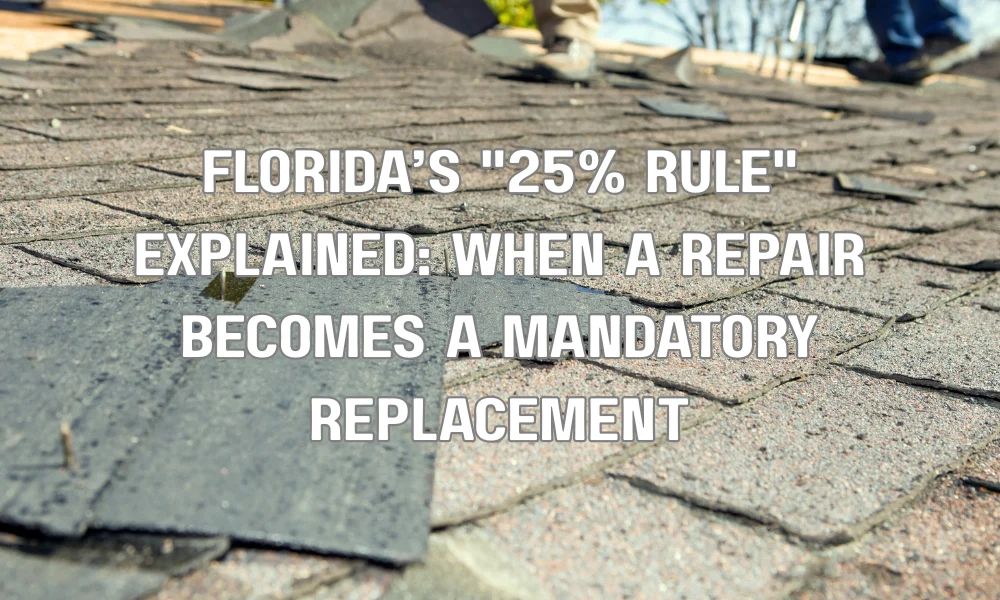
- Florida’s “25% Rule” mandates that if repair costs to a damaged structure exceed 25% of its pre-damage market value, the entire structure must be brought up to current building codes.
- This rule primarily enhances building resilience against natural disasters like hurricanes, improving safety and long-term structural integrity for properties statewide.
- Calculating the 25% threshold involves comparing the estimated repair costs, excluding land value, against the total structure’s value, as determined by local building officials.
- Property owners often face significant financial implications, as mandatory code upgrades can substantially increase repair costs beyond basic damage remediation.
- Understanding your insurance policy’s “Ordinance & Law” coverage is crucial, as it typically covers the additional expenses associated with code compliance triggered by the 25% Rule.
- Proactive measures such as regular maintenance, pre-emptive upgrades, and expert consultation are vital for navigating compliance and mitigating unexpected costs.
- The rule applies broadly across residential and commercial properties, emphasizing Florida’s commitment to robust construction standards for a safer built environment.
Understanding Florida’s “25% Rule” for Property Owners
What is Florida’s 25% Rule and why does it exist?
Florida’s “25% Rule,” codified primarily in the Florida Building Code, dictates that if the cost to repair damage to a structure exceeds 25% of its pre-damage market value (excluding land), the entire structure must be brought into compliance with current building codes. This regulation primarily exists to enhance public safety and improve the resilience of buildings against natural disasters, particularly hurricanes, which frequently impact the state. By ensuring older structures are updated to contemporary standards during significant repairs, the rule actively contributes to a safer and more robust built environment.
Critical Fact 1: The 25% Rule is not about minor repairs; it targets substantial damage or renovation projects where the scale of work warrants comprehensive code compliance, often triggered by events like hurricanes or extensive fires.
How the 25% Rule is Calculated and Applied
How is the 25% threshold calculated?
The 25% threshold is calculated by comparing the estimated cost of repairs for the damaged portions of a building against the total assessed or market value of the structure *before* the damage occurred, explicitly excluding the value of the land. Local building officials play a critical role in this assessment, often requiring detailed estimates from licensed contractors for both the repair work and the total replacement cost of the undamaged structure. Permit valuations for the proposed work are closely scrutinized to determine if they push the project over the critical 25% mark, which then triggers the mandatory upgrades.
What types of damage or repairs typically trigger the 25% Rule?
The “25% Rule” is most frequently triggered by significant damage from natural disasters, such as hurricanes, floods, or severe storms, where structural elements like roofs, walls, or foundations are compromised. It can also apply to extensive fire damage, comprehensive renovations, or accumulated wear and tear that necessitates substantial repair work. While minor cosmetic fixes or non-structural updates typically do not trigger the rule, any repair project involving major components that exceeds the value threshold will demand full code compliance.
| Scenario Type | Repair Cost as % of Structure Value | Total Structure Value (Excl. Land) | Outcome: Repair vs. Mandatory Upgrade | Typical Triggers |
|---|---|---|---|---|
| Minor Damage | 10% | $300,000 | Repair only; no mandatory upgrades. | Small leaks, cosmetic issues, minor wall damage. |
| Moderate Damage | 20% | $300,000 | Repair only; close monitoring. | Sectional roof damage, minor flood damage. |
| Threshold Exceeded | 30% | $300,000 | Mandatory upgrades to current code. | Major roof loss, significant structural damage, extensive fire. |
| Comprehensive Reno | 40% | $500,000 | Mandatory upgrades to current code. | Full gut renovation, significant additions. |
| Major Catastrophe | 55% | $250,000 | Mandatory upgrades to current code (often leads to rebuild). | Severe hurricane damage, near-total loss fire. |
Implications and Compliance for Homeowners and Businesses
What are the mandatory upgrade requirements if the rule is triggered?
If the “25% Rule” is triggered, it means that the entire existing structure, not just the damaged portion, must be brought up to the current Florida Building Code. This can encompass a wide range of upgrades, including enhanced wind mitigation features (e.g., hurricane clips, impact-resistant windows), updated electrical and plumbing systems, new energy efficiency standards, and potentially even elevation requirements in flood zones. The financial implications can be substantial, as these mandatory upgrades often far exceed the cost of merely repairing the original damage.
What is the role of insurance companies and local building departments?
Insurance companies play a dual role: they assess the damage and, depending on your policy, cover the cost of repairs. Crucially, standard policies may not cover the additional expenses incurred by mandatory code upgrades unless you have specific “Ordinance & Law” coverage. Local building departments are the primary enforcers of the “25% Rule.” They review permit applications, calculate the repair-to-value ratio, and conduct inspections to ensure all upgrades meet current code standards, making their interpretation and guidance paramount in the process.
Critical Fact 2: “Ordinance & Law” coverage in your insurance policy is often the difference between adequate recovery and significant out-of-pocket expenses when the 25% Rule mandates costly code upgrades.

Navigating the Process: Challenges and Best Practices
What common challenges arise when dealing with the 25% Rule?
Property owners frequently encounter several challenges when the 25% Rule comes into play. These include disputes over the property’s pre-damage valuation, unexpected and significantly increased project costs due to extensive code compliance requirements, and potential delays in repair or reconstruction due to complex permitting processes. Furthermore, there can be shortfalls in insurance coverage if “Ordinance & Law” provisions are insufficient, leaving homeowners to cover substantial expenses out of pocket. Navigating these complexities often requires expert consultation.
What are the best practices for property owners facing potential 25% Rule triggers?
For property owners facing potential 25% Rule triggers, several best practices can help streamline the process and mitigate financial strain. Firstly, meticulously document all damage with photos and videos immediately after an event. Secondly, engage licensed professionals early—including experienced contractors, public adjusters, and potentially legal counsel—to get accurate repair estimates and understand your rights. Thirdly, thoroughly review your insurance policy for “Ordinance & Law” coverage and understand its limits. Finally, maintain open communication with your local building department to understand their specific interpretations and requirements for compliance.

Specific Scenarios and Exemptions
Are there any exemptions or specific conditions that alter the rule’s application?
While the 25% Rule is broadly applied, certain specific conditions and interpretations can alter its application. Minor, non-structural cosmetic repairs that do not affect the integrity of the building system are generally exempt. Historical properties may also have modified compliance requirements to preserve their architectural character, often necessitating specific approvals. Furthermore, the rule can interact differently with properties in designated flood zones, where additional FEMA regulations and local flood ordinances may impose even stricter elevation or construction standards, potentially overriding or complementing the 25% Rule’s basic application.
How does the rule impact different property types (residential vs. commercial)?
The core principle of the 25% Rule applies consistently across both residential and commercial property types in Florida, aiming to bring structures up to current code after significant damage. However, the specific code requirements triggered can vary significantly. Commercial properties often face more stringent and complex code upgrades related to fire safety, accessibility (ADA compliance), egress, occupancy classifications, and specific use-group requirements. This means the cost and scope of mandatory upgrades for commercial buildings can be considerably higher and more intricate than for a typical single-family residence.

Preparing for Future Resilience
How can proactive measures reduce the impact of the 25% Rule?
Taking proactive measures can significantly reduce the potential financial and logistical impact of the 25% Rule. Investing in preventative maintenance helps extend the lifespan of building components, reducing the likelihood of catastrophic failure. Moreover, pre-emptive code upgrades, such as installing hurricane clips, reinforcing roof-to-wall connections, or upgrading to impact-resistant windows *before* damage occurs, can mitigate the extent of future repairs and potentially avoid triggering the 25% threshold entirely. Most importantly, securing comprehensive “Ordinance & Law” insurance coverage with adequate limits is crucial, as it provides a financial safety net for the unexpected costs of mandatory code compliance.
Critical Fact 3: Proactive investment in wind mitigation and adequate “Ordinance & Law” insurance coverage are the most effective strategies for property owners to minimize the financial shock and disruption associated with Florida’s 25% Rule.
Frequently Asked Questions
Does the 25% Rule apply to all types of damage?
The 25% Rule primarily applies to substantial damage, typically from events like hurricanes, fires, or extensive wear, where the repair costs for the affected portion exceed 25% of the structure’s pre-damage value. Minor cosmetic repairs usually do not trigger it.
How is the “value of the structure” determined for the 25% calculation?
The “value of the structure” is usually determined by the local building department, based on the property’s assessed value (excluding land) or a professional appraisal of the replacement cost of the building before the damage occurred.
What happens if I don’t comply with the 25% Rule?
Failure to comply with the 25% Rule can result in denied permits, stop-work orders, fines, and potential legal action from the local building department. Non-compliant structures may also be difficult to insure or sell.
Will my homeowner’s insurance cover the mandatory code upgrades?
Only if your homeowner’s insurance policy includes specific “Ordinance & Law” or “Building Code Coverage.” Standard policies typically only cover the cost to repair the direct damage, not the additional costs of bringing the entire structure up to current codes.
Can I appeal the building department’s valuation or determination?
Yes, property owners generally have the right to appeal a building department’s valuation or determination. This typically involves presenting independent appraisals and contractor estimates to support a different assessment.
Does the 25% Rule apply to commercial buildings too?
Yes, the 25% Rule applies to both residential and commercial buildings. While the core principle remains the same, commercial properties often face more complex and potentially more expensive code compliance requirements.
How often does the 25% Rule actually get triggered in Florida?
The 25% Rule is frequently triggered, especially after major hurricane seasons or significant disaster events that cause widespread structural damage across Florida properties.
What is “Ordinance & Law” coverage, and how much do I need?
“Ordinance & Law” coverage is an insurance endorsement that covers the additional costs to rebuild or repair a structure to current building codes, even if the damage itself wouldn’t normally require such upgrades. The amount needed depends on your property’s value and the potential cost of code upgrades in your area.
