How to Tell if a Roofing Estimate is Too Good to Be True: A Strategic South Florida Homeowner’s Guide
As a homeowner or business owner in Fort Lauderdale, Hollywood, or anywhere in South Florida, you understand that your roof is more than just a cover over your head – it’s your primary defense against our intense sun, heavy rains, and, most critically, hurricane-force winds. When it comes to something so vital, cutting corners isn’t an option. Yet, in the rush to secure repairs or replacements, especially after a storm, many are tempted by estimates that seem incredibly low. As your trusted, licensed roofing contractor at Shieldline Roofing, I’m here to tell you: if it seems too good to be true, it almost certainly is, particularly in our unique climate governed by stringent Florida Building Code (FBC) requirements.
Navigating roofing estimates can be confusing. My goal is to equip you with the knowledge to discern a legitimate, code-compliant proposal from a deceptive one. We’ll delve into the critical red flags that demand your attention, ensuring your investment in a new or repaired roof is sound, safe, and durable enough to stand up to everything our beautiful but challenging South Florida environment throws at it.
Key Takeaways for South Florida Homeowners:
- Red Flag Pricing: Be wary of estimates significantly lower than competitors. Quality, FBC-compliant roofing has a clear baseline cost for materials and expert labor in our region.
- Verify Credentials: Always confirm a contractor’s active Florida license, comprehensive insurance (Workers’ Comp and General Liability), and local references before committing. This is non-negotiable in South Florida.
- Detailed Contracts are Crucial: A legitimate estimate should be comprehensive, detailing specific FBC-approved materials, labor, warranties, permit acquisition, and timelines.
- Avoid Pressure Tactics: High-pressure sales or demands for immediate decisions are strong indicators of potential fraud, especially common with storm chasers in our post-hurricane environment.
- Quality Over Cheapest: Investing in reputable, licensed contractors like Shieldline Roofing and using quality, HVHZ-rated materials prevents costly repairs and premature roof failure, protecting your property in the long run.
The Price Tag: Too Low for Comfort in a High-Wind Zone?
When you receive a roofing estimate, the price is often the first thing you look at. However, in Fort Lauderdale, Hollywood, and throughout South Florida’s High-Velocity Hurricane Zone (HVHZ), a price that’s dramatically lower than other bids should trigger immediate concern. Quality roofing, especially one designed to meet the rigorous demands of the Florida Building Code, comes with specific material and labor costs that cannot be sustainably undercut without sacrificing quality or compliance.
Understanding South Florida’s Baseline Roofing Costs
A realistic price range for roofing materials and labor in our region accounts for several factors unique to South Florida. This includes the enhanced fastening requirements for shingles and tiles, specialized underlayment like a Secondary Water Barrier to prevent leaks during heavy rains, and the use of materials specifically rated for high winds, often requiring specific product approvals from Miami-Dade County or statewide product approvals. These aren’t optional upgrades; they are **FBC** mandates for resilience.
Material Quality vs. Price: Florida-Rated Matters
The direct correlation between the type and grade of roofing materials and their cost is undeniable. For instance, **Class G asphalt shingles** or specific gauges of metal roofing suitable for our climate will cost more than their lower-grade counterparts not rated for **HVHZ** conditions. Tile roofs (clay or concrete) also vary significantly in cost based on their wind resistance and manufacturing quality. A suspiciously low bid often means the contractor plans to use cheaper, non-compliant materials that will fail prematurely, especially under a tropical storm or hurricane.
Labor Costs & Expertise: Why Experienced, Insured Roofers Command Their Rate
Experienced, licensed, and insured roofers in South Florida command a certain rate because they possess the specialized knowledge to interpret and apply the complex **Florida Building Code**, especially regarding wind mitigation and proper installation techniques. They invest in safety training, proper equipment, and comprehensive insurance policies (Worker’s Compensation and General Liability) that protect both their crews and you, the homeowner. A cheap bid almost always signals a lack of these critical protections, exposing you to significant financial and legal risks if an accident occurs on your property.
The “Discount” Deception: Masking Underlying Issues
How unusually large or inexplicable discounts can mask underlying issues or cut corners. While a small, legitimate discount can be great, watch out for contractors offering massive “today only” discounts that seem too generous. This often indicates they’ve inflated the initial price to make the discount look better, or they’re desperate for your business because they can’t compete on quality or compliance. In South Florida, where **FBC** compliance is paramount, these “discounts” can often mean they plan to bypass essential, costly steps required by code.
Over 30% of homeowners surveyed admit to choosing the lowest bid for home repairs, often regretting it later due to quality issues or hidden costs.
Lack of Transparency: What’s Hiding in Plain Sight?
A reputable contractor provides a clear, comprehensive estimate. In South Florida, where specific codes and unique challenges exist, transparency isn’t just good practice—it’s essential for ensuring your roof is built to last and protect your home.
Vague Descriptions & Missing Florida Requirements
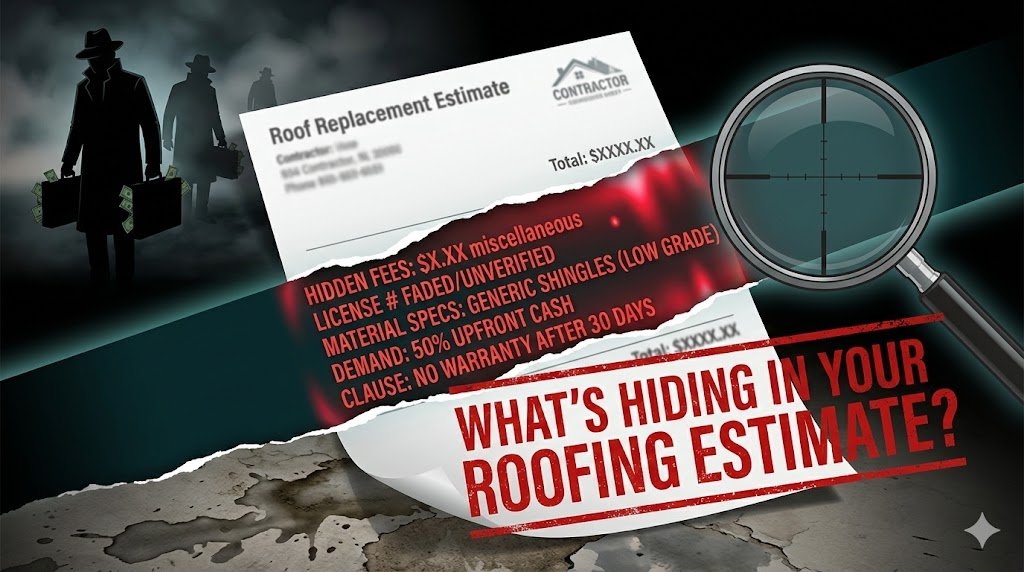
Estimates lacking specifics on material brands, quantities, and detailed installation methods are a huge red flag. For instance, a legitimate estimate from Shieldline Roofing would specify the brand and type of shingles (e.g., “Owens Corning Duration Storm shingles, **Class G** rated”), the type of underlayment (e.g., “**Synthetic underlayment with secondary water barrier application** per **FBC** 2023”), and the exact fastening schedule (e.g., “Six fasteners per shingle, hand-nailed”). Vague terms like “quality materials” or “standard installation” offer no guarantee of **FBC** compliance or durability.
Missing Inclusions/Exclusions: What the Estimate *Doesn’t* Cover
A common tactic of unscrupulous contractors is to omit crucial costs, only to spring them on you later. This is particularly relevant in Fort Lauderdale and Hollywood. What the estimate *doesn’t* cover is as important as what it does. This includes:
- Permits: In South Florida, a roofing permit is legally required. A legitimate contractor will include this fee and handle the application process.
- Debris Removal: Proper disposal of old roofing materials, especially after a storm, can be costly. Ensure it’s explicitly included.
- Flashing: Details about specific flashing around chimneys, vents, and wall intersections are critical, as improper flashing is a common source of leaks.
- Ventilation: Adequate attic ventilation is vital in our hot, humid climate to prevent moisture buildup and extend roof life. Ensure it’s addressed.
- Soffit/Fascia Repair: Often related to roofing, minor repairs might be excluded unless explicitly stated.
Unclear Payment Terms: Protecting Your Investment
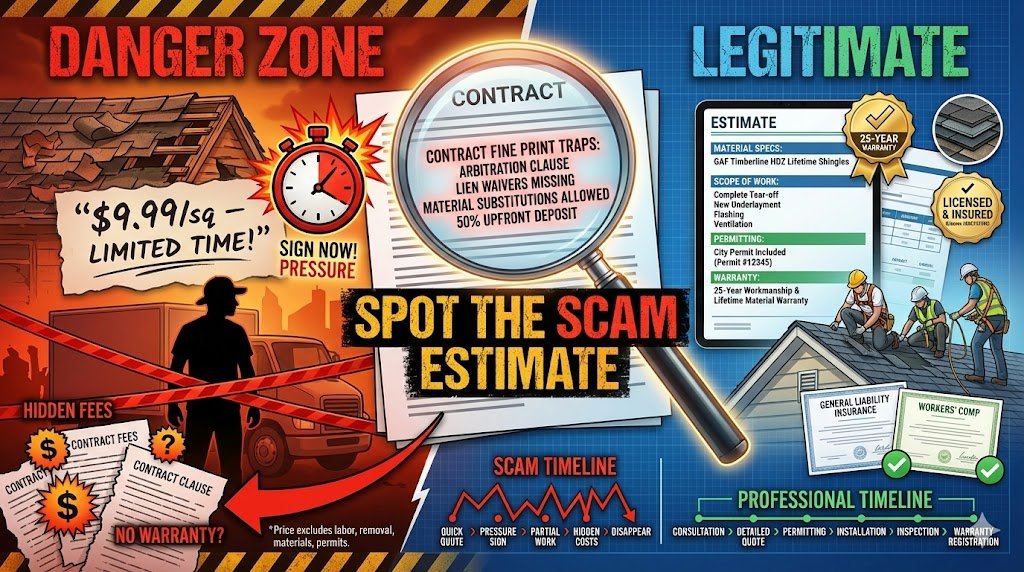
Demands for large upfront payments (especially cash-only deals) or lack of a clear payment schedule should raise alarms. In Florida, it’s customary for a reasonable down payment (often 10-25% for residential projects, with larger percentages allowed for material purchases for specific, high-cost materials) to be collected, with progress payments tied to completed milestones. Be wary of contractors demanding 50% or more upfront, particularly if they haven’t started work or purchased materials. This is a common tactic of fraudsters who take your money and disappear.
Absence of a Written Contract: Your Only Protection
The ultimate red flag – verbal agreements offer no protection. A legally binding, written contract is essential. It should outline everything discussed, from materials and labor to warranties, payment schedules, and a clear start and end date. Without it, you have no recourse if something goes wrong, and proving **FBC** compliance becomes impossible.
Less than 20% of fraudulent contractor cases involve a detailed, legally binding contract, highlighting the importance of thorough documentation.
Missing Credentials & Insurance: A Recipe for Disaster in Our State
In a state prone to hurricanes, the importance of hiring a properly licensed and insured contractor cannot be overstated. This isn’t just about compliance; it’s about protecting your biggest asset and avoiding devastating personal liability.
The Importance of Licensing: Why It’s Non-Negotiable in Florida
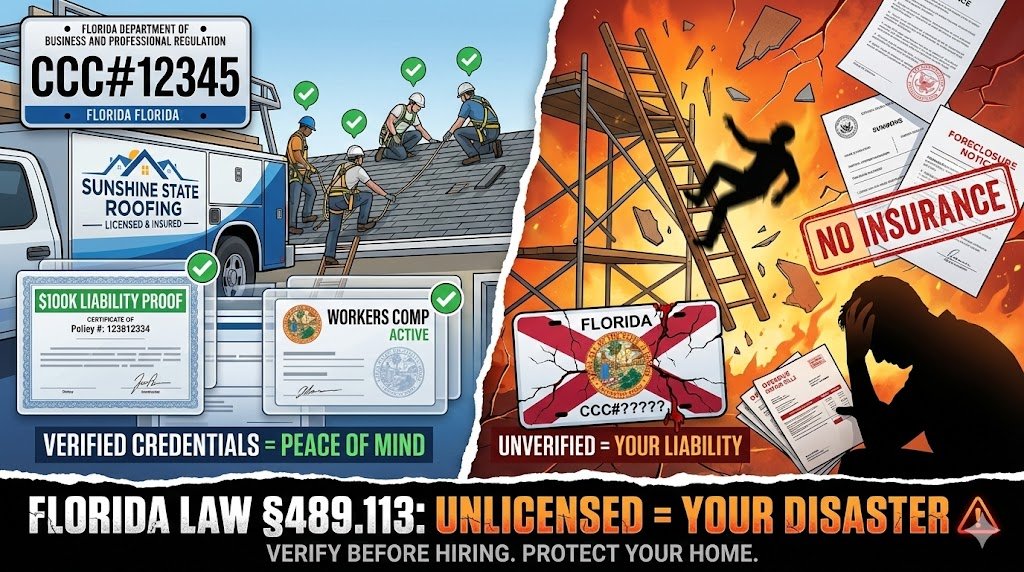
An active, local contractor’s license is your guarantee that the individual or company has met state-mandated qualifications, passed exams, and is held to professional standards. In Florida, this means holding a Certified Roofing Contractor license (or a general contractor license that covers roofing). Unlicensed contractors often don’t understand the complex **Florida Building Code** requirements for wind mitigation, fastening, and material selection specific to our **HVHZ** zones. Hiring an unlicensed contractor can invalidate your home insurance policy, leave you vulnerable to fines, and offer no legal recourse if the work is faulty or unfinished.
Worker’s Compensation & General Liability: Protecting Yourself from Liability
Imagine a worker falling off your roof. If the contractor isn’t carrying Worker’s Compensation insurance, you, the homeowner, could be held responsible for medical bills, lost wages, and potentially permanent disability. Similarly, General Liability insurance protects you if the contractor accidentally damages your property (e.g., a hole through a ceiling) or a neighbor’s property during the project. Always request current certificates of insurance directly from the insurer, not just a copy from the contractor.
Bonding & Guarantees: What Bonding Means for Project Completion
While not always a requirement for residential projects, some contractors are bonded. Bonding provides an extra layer of financial recourse, guaranteeing that the project will be completed according to the contract, even if the contractor defaults. This is particularly relevant for larger commercial projects, but even for residential work, it speaks to a contractor’s financial stability and commitment. Shieldline Roofing stands by its work with comprehensive warranties and a commitment to quality that ensures your peace of mind.
Checking References & Reviews: Beyond Online Searches
Beyond online reviews, always request local client references. A reputable contractor like Shieldline Roofing will be proud to share contacts of previous clients in Fort Lauderdale, Hollywood, and surrounding areas. Take the time to call these references and, if possible, drive by previous job sites to inspect their work firsthand. Look for consistency in quality, cleanliness, and overall professionalism. Be wary of contractors who are unwilling to provide references or whose online reviews seem suspiciously sparse or overly generic.
Unlicensed contractors are responsible for over 70% of reported home improvement scams, underscoring the critical need for verification.
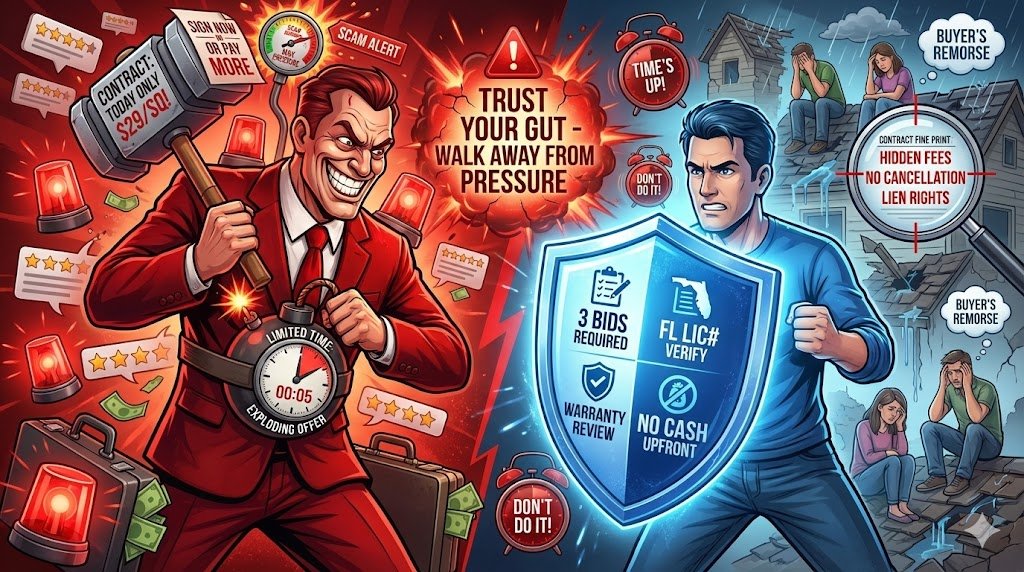
Pressure Tactics & Instant Decisions: Your Gut Feeling Matters
Legitimate contractors understand that major home improvements like roofing require careful consideration. Anyone pressuring you for an immediate decision is likely trying to hide something or prevent you from getting competitive bids and verifying their credentials.
“Limited Time Offers”: A Classic South Florida Red Flag
Tactics designed to bypass critical thinking and comparative shopping are common with predatory contractors, especially after a hurricane. “This price is only good if you sign today” or “I can give you a special discount if you commit right now” are high-pressure sales pitches meant to disarm you. A reputable contractor will provide a written estimate and allow you a reasonable amount of time to review it, get other bids, and make an informed decision without feeling rushed.
On-the-Spot Sign-Ups: Time to Review Your **FBC**-Compliant Contract
Demands to sign contracts immediately without time for review or legal consultation are a strong indicator of potential fraud. You should have ample opportunity to scrutinize every detail, ensure all **FBC** requirements are explicitly mentioned, and understand your rights and obligations. Never sign a contract you haven’t fully read and understood. If a contractor rushes you, politely decline and seek other options.
High-Pressure Sales Pitches: Aggressive Language and Scare Tactics
Aggressive language, scare tactics about impending doom (e.g., “your roof will collapse in the next storm!”), or fabricated price increases are designed to instill fear and push you into an immediate, ill-advised decision. A professional roofing expert, like those at Shieldline Roofing, will educate you on the condition of your roof, explain necessary repairs or replacements in a clear, factual manner, and provide solutions without resorting to intimidation.
Refusal to Provide Written Estimates for **FBC**-Compliant Work
Any contractor unwilling to formalize their bid in writing, detailing all aspects of the job including materials, labor, warranties, and adherence to the **Florida Building Code**, should be avoided. A verbal quote is meaningless and offers you no protection whatsoever. Always insist on a detailed, itemized written estimate that you can compare against other bids.
Homeowners subjected to high-pressure sales tactics are 2.5 times more likely to report dissatisfaction or fraud compared to those with a standard bidding process.
Substandard Materials & Shoddy Workmanship: The Hidden Costs in Hurricane Country
A roof that doesn’t meet **Florida Building Code** standards or uses subpar materials is not just a cheap fix; it’s a ticking time bomb, especially in our hurricane-prone region. The hidden costs far outweigh any initial savings.
The Lure of Cheap, Non-**FBC**-Compliant Materials
How low-grade shingles or accessories drastically reduce roof lifespan and effectiveness. Using asphalt shingles not rated for **HVHZ** winds, thin-gauge metal, or non-approved tile fastening systems will lead to premature failure, leaks, and potential catastrophic damage in the next tropical storm or hurricane. These materials often fail to meet manufacturer warranty requirements when installed in South Florida, leaving you without coverage. Shieldline Roofing only uses **FBC**-approved, high-quality materials designed to withstand our local climate.
Skipping Essential **FBC** Installation Steps
Common corners cut in installation include inadequate underlayment (e.g., skipping a **secondary water barrier**), improper flashing at crucial junctures, incorrect fastening schedules (using too few nails, or nails that are too short), or poor attic ventilation. These omissions directly violate the **Florida Building Code** and significantly compromise your roof’s integrity, leading to leaks, mold growth, and premature roof failure – all costly problems down the line that could have been avoided with proper installation from the start.
Lack of Warranty: Understanding Your Protection in Florida
Understanding the difference between manufacturer warranties (covering material defects) and contractor workmanship warranties (covering installation errors) is crucial. A reputable contractor will offer both. A “too good to be true” estimate often comes with no warranty, or a vague one that’s impossible to enforce. Always ensure the warranty is written, clear, and includes terms specific to South Florida conditions. Remember, an invalid **FBC** installation can void a manufacturer’s warranty entirely.
Future Repair Headaches: The Inevitable Consequence of Poor Work
How poor initial work guarantees more frequent and costly repairs down the line. A roof installed with subpar materials or workmanship can fail up to 50% earlier than its expected lifespan, leading to significant replacement costs. In South Florida, this means your “cheap” roof might only last 5-10 years instead of 20-30, leaving you to pay for another full replacement much sooner than anticipated – a devastating financial hit.
The “Storm Chaser” Phenomenon: Beware of Opportunists in South Florida
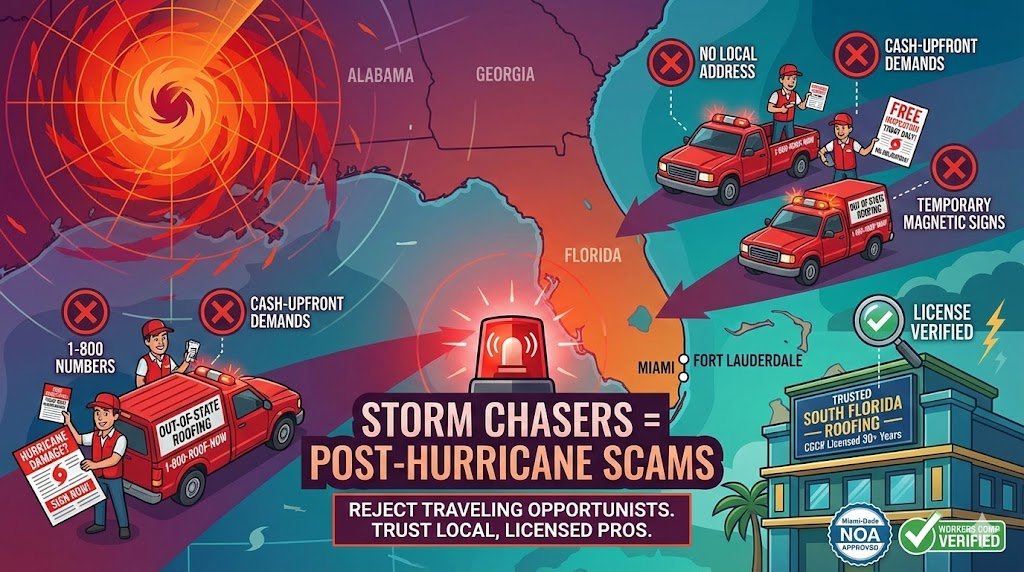
After a hurricane or severe storm, our region unfortunately becomes a magnet for “storm chasers” – out-of-state contractors who arrive looking to make quick money, often at the expense of vulnerable homeowners.
Post-Disaster Scams: Unsolicited Inspections and Immediate Work
Be extremely wary of contractors who appear immediately after a storm, often from out of state, offering unsolicited inspections and immediate work. Legitimate local contractors, like Shieldline Roofing, are usually busy with existing clients and emergency repairs. Storm chasers often pressure homeowners into signing contracts on the spot, promising quick fixes without proper permits or adherence to the **Florida Building Code**.
Insurance Fraud: Inflated Claims and Misleading Advice
Tactics involving inflated damage claims or pressuring homeowners to file claims unnecessarily are common with storm chasers. They might promise to handle your insurance claim entirely, encouraging you to sign an “Assignment of Benefits” (AOB) that gives them control over your insurance payout. While AOBs can be legitimate, they have been widely abused in Florida and can leave homeowners with little control or recourse if the contractor performs shoddy work or inflates costs. Always consult with your insurance company directly and consider a Public Adjuster if you need help with a complex claim, but retain control over your property and contractor choice.
Temporary Fixes, Permanent Problems: No **FBC** Compliance
These opportunists often perform quick, cheap, and ineffective repairs that don’t address underlying issues or meet **FBC** requirements. These “band-aid” solutions leave your roof vulnerable to future damage and can actually complicate legitimate repairs down the line. Shieldline Roofing focuses on permanent, code-compliant solutions to ensure your safety and investment.
Demands for Upfront Payment: A Classic Escape Tactic
Storm chasers frequently demand significant upfront cash payments, often disappearing once payment is received, leaving homeowners with unfinished or shoddy work, and no way to recover their money. Always verify a contractor’s physical local address and insist on a detailed contract with a reasonable payment schedule tied to work completion. In South Florida, reports of roofing contractor fraud can surge by as much as 400% in affected areas following major weather events.
FAQs for South Florida Roofing
What is a reasonable price range for a new roof or major repair in Fort Lauderdale?
A reasonable price for a new roof or major repair in Fort Lauderdale, Hollywood, or the surrounding South Florida area can vary significantly based on roof size, pitch, material choice (asphalt, metal, tile), and accessibility. However, expect costs to reflect the stringent **Florida Building Code** requirements for wind resistance, underlayment (like a **secondary water barrier**), and local labor rates. A quality asphalt shingle roof might range from $10,000 to $25,000+, while metal or tile can easily exceed $30,000 to $60,000+ for an average home. Always get multiple bids from licensed, insured local contractors to establish a realistic baseline, and be suspicious of bids significantly below the average.
How many roofing estimates should I obtain before making a decision?
We recommend obtaining at least three detailed estimates from different licensed and insured local roofing contractors in South Florida. This allows you to compare pricing, proposed materials, installation methods, warranties, and contractor professionalism. Remember to compare apples to apples – ensure all estimates detail the same scope of work and **FBC**-compliant materials.
What specific red flags should I look for when reviewing a roofing contract in Florida?
Beyond the general red flags, specifically in Florida, look for:
- Absence of the contractor’s valid Florida license number.
- Lack of explicit mention of **Florida Building Code** compliance.
- Vague descriptions of underlayment, flashing, or fastening schedules.
- Failure to mention permit acquisition and inspections.
- No specific material brands or models, especially those rated for **HVHZ** zones.
- “Assignment of Benefits” (AOB) clauses without full understanding.
- Payment terms demanding excessive upfront cash.
How can I verify a roofing contractor’s license, insurance, and reputation in South Florida?
To verify a contractor’s license in Florida, visit the Florida Department of Business and Professional Regulation (DBPR) website. For insurance, ask the contractor for current certificates of Workers’ Compensation and General Liability insurance, and call the insurance providers directly to confirm coverage for your specific project dates. For reputation, check local online review platforms (Google, Yelp, BBB), ask for local references (and call them!), and confirm they have a physical local office in Fort Lauderdale, Hollywood, or a nearby South Florida city.
What should I do if I suspect a roofing estimate is too good to be true, or if I’ve been scammed?
If an estimate seems too good to be true, trust your instincts and walk away. Get more bids and verify everything. If you believe you’ve been scammed, first contact local law enforcement and the Florida DBPR to report the unlicensed activity or fraud. You can also file a complaint with the Florida Attorney General’s Office or local consumer protection agencies. Gather all documentation: contracts, estimates, payment records, and communication. Shieldline Roofing is also here to offer advice and, if possible, help rectify the situation with code-compliant solutions.